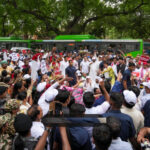
Hundreds of protesters, including students, women and civil society activists, assembled at Freedom Park on October 8, alleging that the Election Commission’s voter verification exercise had resulted in wrongful deletions and threatened citizens’ electoral rights.
The demonstration, organised by the CJP alongside civil society organisations, featured a people’s tribunal where individuals claiming to have been affected by electoral roll revisions were invited to present their grievances.
Protesters raised slogans demanding that the SIR exercise be scrapped and Kumar relinquish his position. Organisers accused the Election Commission of failing to ensure transparency and accountability while undertaking changes to electoral registers.
Addressing the gathering, Rathee rejected suggestions that his participation was intended to destabilise the government or advance an opposition political campaign.
“I have not come here for regime change. Neither Elon Musk nor George Soros has funded me. I have come here with my own money,” he told demonstrators.
Rathee maintained that electoral integrity transcended party affiliations and affected every citizen entitled to vote.
“Whether you vote for the BJP, whether you vote for the Congress, or whether you support any other party, this is an issue that concerns every citizen of the country,” he said.
He accused the Election Commission of operating without adequate public scrutiny, alleging that there was “zero transparency, zero accountability” in its handling of electoral matters.
Prakash Raj also criticised the commission’s functioning and questioned Kumar’s independence. He alleged that the election authorities were acting under political influence, naming Prime Minister Narendra Modi and Union Home Minister Amit Shah.
Those allegations remain contested, and the demonstration presented no independently established finding that the commission had deliberately manipulated electoral rolls.
Dipke, who has emerged as a prominent organiser of protests against the SIR, accused the ruling Bharatiya Janata Party of benefiting from alleged voter deletions.
He claimed that the revision process was being used to remove voters perceived as opponents of the BJP, describing the alleged practice as an attack on democratic representation.
The CJP founder demanded Kumar’s resignation and declared that demonstrations would continue until the movement’s demands were addressed.
His accusations against Modi and the Election Commission were political allegations rather than established findings of electoral misconduct.
The protest highlighted growing disputes over the SIR, a process through which the Election Commission undertakes intensive verification of electoral registers, including identifying duplicate entries, deceased voters and people no longer ordinarily resident at registered addresses.
Opponents argue that documentation requirements and administrative errors can result in eligible voters being excluded, particularly when affected individuals face difficulties challenging deletions.
The commission maintains that electoral roll revisions are necessary to preserve accurate voter records and protect the integrity of elections. The stated purpose of the exercise is to ensure that eligible citizens remain registered while ineligible entries are removed.
Whether particular deletions were improper requires examination of individual electoral records and the procedures followed by election officials.
At Freedom Park, organisers invited people from different parts of Karnataka to describe alleged difficulties with their voter registrations.
CJP co-convener Ashutosh Ranka said the tribunal was intended to provide a platform for citizens who believed their names had been wrongly removed.
Participants were encouraged to explain their experiences directly rather than relying exclusively on political speeches.
Organisers also announced a footwear-themed demonstration, described as a chappal protest, intended to express solidarity with women and underline public dissatisfaction with the electoral authorities.
The Bengaluru gathering formed part of a wider campaign challenging the commission’s handling of electoral revisions and demanding greater institutional accountability.
The CJP has announced another demonstration at Jantar Mantar in New Delhi on October 10, with organisers seeking participation from youth groups, students and other supporters.
Thursday’s event also featured CJP representatives and activists carrying placards criticising Kumar. Participants repeatedly called for the restoration of names they alleged had been improperly excluded from voter lists.
The organisers said testimonies collected during the people’s tribunal would help draw attention to individual complaints about electoral registration and verification procedures.