By Dr. Gyan Pathak
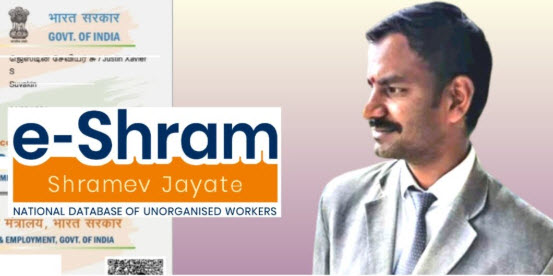
India celebrated five-years of e-Shram portal on August 26. Prime Minister Narendra Modi led Government of India enumerated its achievements narrated how the e-Sharm portal launched on August 26, 2021 emerged as one stop solution for informal workers on October 21, 2024. Numerous things were said in eulogy, but skipped the basic question that an informal worker asks after registering on e-Shram, “Will I have work, will it be dignified, will my income will secure, and will I be fully protected under social security coverage?”
Answers to all such questions are shrouded in uncertainty that makes us to think that India must go beyond celebrating five-years of e-Shram portal and create decent works with full social security coverage in place of merely giving partial social security coverage to informal workers as tokenism, only to show that the government is doing a lot of things to the welfare of informal workers.
One must distinguish between creating a database of informal workers and actually creating decent work and universal social security. E-Shram has, of course, registered remarkable achievements in the last fiver years if we go by the data. Total registration made until now are 31.89 crore. About 54.28 per cent of them are women and 45.72 per cent are men. About 0.08% are aged 16-18 years, 55.21% of registered workers are aged 18–40 years, 24.18% are aged 40–50 years and 20.53% are above 50 years as on 20 August, 2026. Agriculture, Domestic and Household Workers, Construction, and Apparel account for the highest registrations. Highest number of informal workers are registered from Uttar Pradesh, Bihar, West Bengal, Madhya Pradesh, and Maharashtra.
On the one hand, the data itself is revealing of serious problem in the labour market, such as youth workers are in largest number in informal sector, which indicates that opening for decent regular jobs have been narrowing in the last five years. The government had initial target of registering 40 crore workers, but even after intervention of the Supreme Court of India, after the migrant crisis during Covid-19 crisis, only 31.89 crore could be registered as of now, which is a sad commentary of performance of the government. Even according to the government data 55 crore workers are in informal sector apart from 2.25 crore informal workers in the formal sector. Anomalies are also seen in inter-state and inter-sectoral registration of workers, which needs to be addressed. However, the greatest and perhaps the central weakness of e-Shram remains the gap between the registration and the rights of workers.
The launch of e-Shram was considered an important intervention for providing some social security coverage to informal workers. It was because, one of the biggest obstacles to extending social security coverage was the absence of a reliable database. E-Sharm sought to address this problem by creating the National Database of Unorganised Workers (NDUW), including migrant workers, construction workers, domestic workers, gig and platform workers and others. Now after registration of 31.89 crore informal workers, the fundamental question is not that how many workers have an e-Shram card, but how many workers have acquired decent work and meaningful social security because of it.
This is a pertinent question because e-Shram portal has been transformed from a worker registry into a unified service delivery platform with the launch of the e-Shram One-Stop Solution on 21 October 2024. It now integrates welfare, employment, skilling and pension services. This aligns with wide range of labour services, and registered workers can access eligible schemes and view benefits already received. The platform also promotes convergence across government portals. It strengthens access to social security and improves service delivery for unorganised workers.
The one-stop solution brings together 15 social security and welfare schemes, which includes Pradhan Mantri Shram Yogi Maan-Dhan Yojana (PM-SYM), Pradhan Mantri Suraksha Bima Yojana (PMSBY), Pradhan Mantri Jeevan Jyoti Bima Yojana (PMJJBY), National Social Assistance Programme (NSAP), One Nation One Ration Card (ONORC), Pradhan Mantri Awaas Yojana–Gramin (PMAY-G) and others.
Registered workers can also enrol in the Pradhan Mantri Suraksha Bima Yojana (PMSBY) and Pradhan Mantri Jeevan Jyoti Bima Yojana (PMJJBY). Under PMSBY, workers are eligible for accidental insurance benefits of ₹2 lakh for accidental death or permanent disability and ₹1 lakh for partial disability. PMJJBY provides a life insurance cover of ₹2 lakh in the event of death due to any cause.
The portal also connects workers with the National Career Service (NCS) for employment opportunities. It also provides access to the Skill India Digital Hub for skilling and apprenticeship. Workers can also use myScheme to identify government schemes for which they may be eligible. Through the portal, eligible workers can enrol in the Pradhan Mantri Shram Yogi Maan-Dhan (PM-SYM) Scheme, which offers a minimum assured pension of ₹3,000 per month upon attaining the age of 60 years, subject to eligibility. Powered by the Bhashini platform, multilingual functionality in 22 languages was introduced in 2025.
The greatest achievement of e-Shram is that it has made a large section of India’s informal workforce statistically and administratively visible. However, invisibility to identification is the database is not protection, since a database is never a social-security system. The danger is that registration itself can become a proxy for welfare delivery. A worker may possess an e-Shram card without having access to unemployment protection, health insurance, pension, maternity protection, employment security or an enforceable minimum wage. The card identifies vulnerability, but it does not necessarily remove it.
ILO has already identified the next challenge after the initial expansion of e-Shram, which are data sharing, verification and actually linking workers to social-security and welfare entitlements.
Actual position is that 31.89 crore out of over 57 crore informal workers in the country are registered but decent work – productive work, fair income, security at the workplace, social protection, rights at work and opportunities for workers to participate in decisions affecting their lives – for them remains elusive.
When viewed through this perspective, e-Shram’s five-year journey exposes a fundamental contradiction in India’s labour policy. ILO has noted improvement but has also criticized for leaving important gaps in labour protection.
Slow progress in registration also exposes the problem of digital welfare architecture. Those most in need of protection are the least capable of navigating digital systems independently. Thus e-Sharm has simplified administration for the state, but has simultaneously created a new form of exclusion for informal workers.
India must recognise that digital divide is actually labour rights divide that we have seen in MGNREGA scheme now replaced by VB G RAM G. Moreover, government systematically sabotaged the MGNREGA. In the first month of the implementation of VB G RAM G in July 2026, employment given were only at about 7.67 crore person-days, almost 50 per cent lower, compared to 15.33 crore person-days under MGNREGA in July 2025. Even employment during April–July 2026 under this scheme was around 43% below the average of the corresponding period of the previous two years.
In such scenario, what value remains in merely registering the informal workers, without giving them job and complete social security coverage? India’s informal workers do not merely need a database. They need a portable and predictable floor of social protection. However, this will be the great challenge for the government in the days ahead. (IPA Service)