By K Raveendran
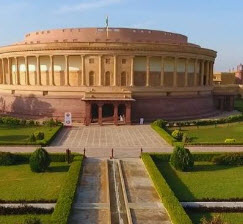
Another session of Parliament has closed with an uncomfortable sense of déjà vu. Repeated adjournments, slogan-shouting, demonstrations inside and outside the chambers and legislation moving through amid uproar have again raised the question of whether Parliament is performing the function for which representative democracy created it. The problem is no longer simply that precious parliamentary time is being wasted. The deeper problem is that political debate itself is migrating elsewhere.
The current Monsoon Session, scheduled for 19 sittings between July 20 and August 13, has repeatedly been disrupted by confrontations between the government and the Opposition, including demands for ministerial statements and protests over issues ranging from student agitations to legislation. Bills have nevertheless been passed amid the din, including measures that went through the Lok Sabha without substantive debate.
That pattern is troubling, although describing every parliamentary session as a washout would go too far. The Monsoon Session of 2025 was particularly damaging: roughly two-thirds of scheduled parliamentary time was lost to disruptions and Question Hour was severely affected. Yet the Winter Session that followed saw the Lok Sabha work for 103 per cent of scheduled time and the Rajya Sabha for 104 per cent. The Budget Session of 2026 was productive enough to be extended for additional legislative business.
That distinction matters. Parliament has not become incapable of functioning. Political parties have become increasingly willing to prevent it from functioning when disruption serves their immediate strategy. The familiar estimate that parliamentary proceedings cost about Rs 2.5 lakh a minute adds an easily understood monetary dimension to the waste. During disruptions in the Budget Session this year, that figure was used to calculate losses running into tens of crores of rupees. But money is actually the least significant loss. Parliament can recover expenditure. It cannot so easily recover the erosion of its institutional authority.
A legislature exists not merely to vote. If voting were its only purpose, parliamentary majorities could conduct most legislative business electronically in a fraction of the time. Parliament exists because legislation is supposed to survive interrogation. Ministers must explain themselves, Opposition members must expose weaknesses, backbenchers must raise inconvenient local concerns, committees must examine detail and the government must defend the consequences of what it proposes. When legislation is passed amid shouting, both sides may obtain politically useful video footage, but the public loses the deliberative stage of democracy.
This is happening just as another democratic arena has become extraordinarily powerful. Social media is increasingly where politicians explain policies, attack rivals, respond to controversies and construct direct relationships with voters. Prime Minister Narendra Modi and other political leaders are intensifying their use of Instagram and other platforms to reach younger voters, while political movements themselves are demonstrating an ability to originate online and move rapidly into street mobilisation.
The smartphone has therefore acquired something Parliament once enjoyed almost exclusively: the ability to connect political leaders with a mass national audience. There is a democratic gain here that should not be dismissed merely because it unsettles traditional institutions. An MP addressing constituents through Instagram, YouTube, X or WhatsApp is potentially more accessible than an MP making a seven-minute intervention in Parliament that few constituents will ever watch. Citizens can reply, challenge, circulate documents, produce counter-arguments and organise around an issue within hours.
Politics consequently becomes less dependent on Delhi. That is potentially transformative. Representative democracy was designed in an age when gathering millions of citizens into a continuous political conversation was technologically impossible. People elected someone to travel to the capital and speak on their behalf because there was no practical alternative.
Technology has changed that constraint. It is therefore reasonable to ask whether Indian democracy should acquire instruments of direct participation alongside Parliament. Citizens could be consulted electronically on major legislation. Parliamentary committees could open structured national consultations before contentious Bills are finalised. Verified citizens could submit questions that acquire parliamentary priority after crossing specified thresholds. Constituencies could periodically indicate their preferences on important national issues, giving MPs a clearer picture of public opinion than party whips or television studios provide.
The logical extreme is the referendum. India, however, cannot simply start holding binding national referendums whenever Parliament confronts an important question. The constitutional architecture is overwhelmingly representative, and the Supreme Court has previously made clear that public opinion must operate through constitutionally established institutions rather than an improvised referendum mechanism. Constitutional amendments themselves are governed by Article 368 and, for specified changes, require ratification by state legislatures.
More importantly, referendums are not automatically more democratic merely because everyone votes. A complicated question involving taxation, federalism, minority rights, national security or economic regulation cannot always be reduced honestly to Yes or No. A government capable of choosing the wording of a referendum can influence its outcome. A wealthy political campaign can overwhelm weaker voices. Social-media algorithms reward anger, certainty and emotional simplicity precisely when democracy sometimes requires hesitation, compromise and technical detail.
The digital public square has its own version of parliamentary shouting. Bots, coordinated political campaigns, misinformation, edited videos and algorithmic amplification can create an exaggerated impression of popular opinion. Research into political activity on social platforms has already shown how coordinated amplification can make political divisions appear larger and more spontaneous than they actually are. A viral hashtag is therefore no more automatically representative of India than a desk-thumping protest inside the Lok Sabha.
The answer is not to replace Parliament with the smartphone. It is to force Parliament to learn from the smartphone. Digital democracy can expand participation before Parliament decides. Citizens could be given better mechanisms for petitions, consultations and interaction with parliamentary committees. Draft legislation could be exposed to public scrutiny earlier. MPs could be required to explain important votes to their constituencies. Parliamentary questions emerging from demonstrable public concern could receive protected discussion time. Technology could reconnect representative democracy with the represented.
But the final obligation to argue, negotiate and decide must remain somewhere accountable. That somewhere is Parliament.
The danger today is that political parties increasingly appear to value Parliament as a television set rather than as a debating chamber. The government wants legislation passed; the Opposition wants confrontation registered; both sides want clips suitable for circulation outside the House. What was once the principal political event becomes raw material for the actual contest taking place on phones. Parliament will not regain authority by demanding that citizens respect it. It will regain authority only when MPs make proceedings worth watching again. (IPA Service)