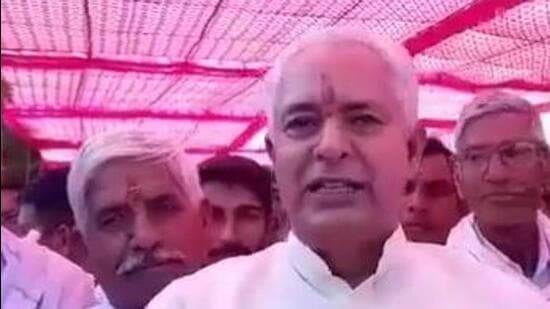
Umer Ahmed Ilyasi, chief imam of the All India Imam Organisation, and Maulana Sajid Rashidi, president of the All India Imam Association, were among clerics who publicly disagreed with Ansari after his address at the A. G. Noorani Memorial Lecture in New Delhi.
Ansari, speaking at the event, cited an observation attributed to former prime minister Jawaharlal Nehru and recorded by former foreign secretary Jagat Singh Gundevia that “the real danger to India” was not communism but “Hindu right-wing communalism”. He referred to the passage while discussing constitutional expert A. G. Noorani’s 2019 book, The RSS: A Menace to India, and broader questions surrounding civic nationalism.
Ilyasi said Ansari’s comments risked provoking Muslims and disturbing the country’s atmosphere. He also argued that criticism of the RSS should take account of statements by RSS chief Mohan Bhagwat that emphasised common ancestry among citizens and rejected the idea that Muslims should be excluded from the nation.
The imam accused Ansari of trying to rebuild his standing among Muslims after leaving constitutional office, a claim for which he presented no evidence. His criticism nevertheless underlined the extent to which Ansari’s intervention has generated disagreement not only between political parties but also among Muslim public figures.
Rashidi took a different line while rejecting any suggestion that Muslims should be treated as outsiders. He said people who had occupied high constitutional posts carried a responsibility to speak for all sections of society and questioned why Ansari was raising such issues after leaving office.
Rashidi said Muslims were proud to live in the country and stressed that extremism became objectionable when it fostered hatred against another community. He called for action against inflammatory statements regardless of which religious group was targeted.
The controversy began after Ansari’s memorial lecture, where he drew on Noorani’s writings to discuss the relationship between nationalism, religion and citizenship. Ansari’s remarks were framed around what he described as threats posed when cultural nationalism creates distinctions among citizens on the basis of faith.
His comments also drew attacks from the Bharatiya Janata Party and the Vishwa Hindu Parishad. Uttar Pradesh Chief Minister Yogi Adityanath described the remarks as unfortunate and said people who had held high constitutional positions should preserve the dignity associated with those offices.
The VHP’s national spokesperson Vinod Bansal accused Ansari of displaying hostility towards Hindu society and challenged the former vice president’s characterisation of right-wing communalism. Those accusations were political responses to Ansari’s speech rather than independently established findings.
Ansari served as vice president from 2007 to 2017. His speech did not describe Hindus generally as extremists; the disputed passage specifically referred to “Hindu right-wing communalism”, while the wider address dealt with Noorani’s critique of the RSS and the meaning of civic nationalism.
That distinction has become central to the argument surrounding the speech. Critics have portrayed the remarks as an attack on Hindu society or the RSS, while Ansari’s formulation, as reported from the lecture, cited a historical warning about a particular form of communal politics.
Ilyasi urged public figures to support statements that encourage coexistence and said Muslims should not be provoked by political or religious rhetoric. He said the community was capable of judging such remarks independently and appealed for restraint.
Rashidi similarly emphasised that communal peace depended on avoiding language that placed one religious community against another. His comments also rejected the idea that Muslims needed political validation from former officeholders.
The disagreement has therefore widened beyond a routine party exchange, with clerics challenging Ansari’s choice of language and timing while also asserting Muslims’ equal place in the country. Their interventions have centred less on Noorani’s historical critique than on the present-day consequences of statements that can be interpreted through a communal lens.