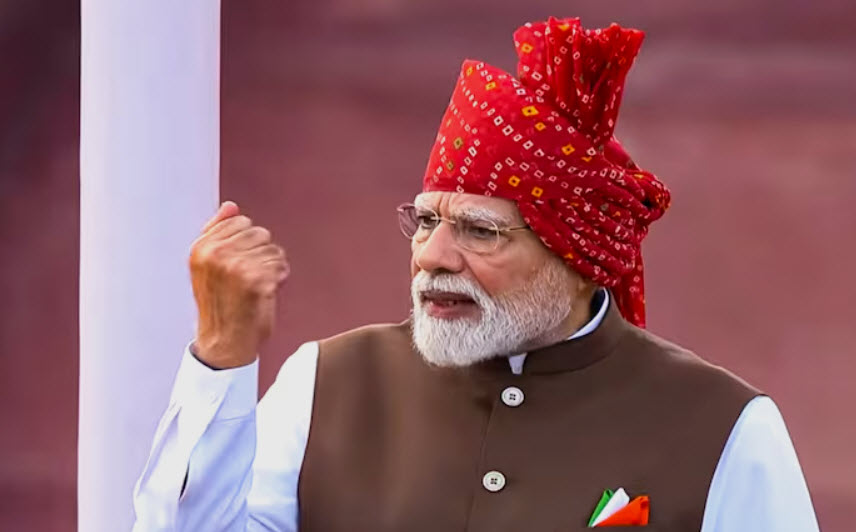
Prime Minister Narendra Modi on Saturday unveiled a seven-part development framework aimed at accelerating India’s drive towards self-reliance and developed-country status by 2047, placing manufacturing, agriculture, technology and strategic capability at the centre of the next phase of growth.
Addressing the nation from the Red Fort on the 80th Independence Day, Modi described the framework as “Shakti Ki Saptadhara”, or seven streams of strength. He said these streams represented areas where India already possessed significant capabilities but needed to expand capacity, competitiveness and global influence.
The seven streams identified by the Prime Minister are manufacturing power, agriculture and food production, technology and innovation, Gati Shakti infrastructure, defence power, the green and blue economy, and India’s soft power. Modi linked their development to the broader goal of building an Aatmanirbhar Bharat and achieving Viksit Bharat by 2047.
Manufacturing received particular emphasis. Modi called for India to develop complete domestic value chains rather than remain dependent on imported components for finished products. He said the country needed capabilities extending from design and individual components to complete manufacturing, while competing internationally on cost, scale and quality.
The Prime Minister stressed that quality would determine India’s ability to establish itself as a dependable production centre in global supply chains. He urged manufacturers, entrepreneurs and micro, small and medium enterprises to make reliability and precision central to their operations, while improving packaging and usability for international markets.
Agriculture and food production formed the second stream. Modi placed greater value addition, food processing and productivity among the priorities needed to raise farm incomes and strengthen food security. The approach also reflects efforts to move agriculture beyond primary production towards processing, branding and larger domestic and export markets.
Technology and innovation were presented as another major source of national strength. Modi’s speech placed advanced technology, semiconductors, artificial intelligence and next-generation communications within the wider self-reliance agenda. He announced a push to train one crore young people in artificial intelligence and said seven to eight semiconductor plants were expected to emerge over the next one to two years.
Infrastructure and connectivity were grouped under Gati Shakti, the fourth stream. The programme seeks to integrate transport, logistics and infrastructure planning while reducing bottlenecks that raise production costs. Modi argued that faster movement of goods, improved connectivity and coordinated infrastructure development would strengthen the competitiveness of both industry and agriculture.
Defence power was identified as the fifth stream. The government has sought to expand domestic defence manufacturing, reduce reliance on overseas suppliers and increase exports of military equipment. Modi placed defence capability within the broader concept of economic and technological self-reliance, linking strategic security with domestic industrial capacity.
The sixth stream covers the green and blue economy. Modi highlighted clean energy, maritime resources and technological investment as areas capable of supporting growth while reducing dependence on imported energy and raw materials. He also referred to expanded exploration of offshore resources, saying almost the entire coastal area had been opened for exploration under the Samrudhha Manthan initiative.
Energy security featured prominently in the address. Modi set a target of reaching 100 gigawatts of nuclear power capacity by 2047, alongside wider investment in renewable energy and other domestic sources. The push is intended to support rising electricity demand from manufacturing, digital infrastructure, transport and urbanisation while limiting exposure to volatile international energy markets.
India’s soft power formed the seventh stream. Modi said cultural influence, traditions, knowledge systems and the country’s growing international profile could complement economic and technological strength. The government has increasingly sought to use culture, tourism, yoga, creative industries and diplomatic engagement to expand India’s influence abroad.
Youth were positioned across all seven streams rather than treated as a separate sector. Modi said the country’s young population would provide the skills, entrepreneurship and technological capacity needed to sustain the transformation. Alongside AI training, he announced free online coaching for examination aspirants and a nationwide system to identify sporting talent among children.
The Saptadhara framework broadens Modi’s long-running self-reliance programme by linking industrial policy with agriculture, infrastructure, defence, energy and cultural influence. It also signals a stronger emphasis on building domestic capabilities across entire supply chains rather than concentrating solely on final assembly or consumption-led expansion.
(IPA Service)