By Ashok Nilakantan Ayers
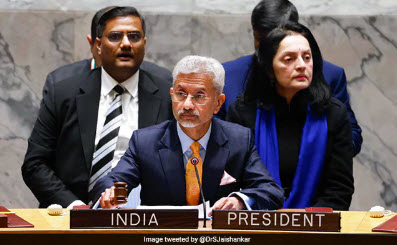
NEW YORK: External Affairs Minister S Jaishankar arrived at the 81st UN General Assembly with an unusually broad diplomatic canvas before him. In meetings with European, Ukrainian, Arab, Asian and other counterparts, India was simultaneously talking to countries that sit on opposite sides of some of the world’s sharpest geopolitical divides.
His central message, delivered most explicitly at the inaugural Partners for Multilateralism, International Law, Peace and Prosperity (P4M) Summit, was that the international system is under strain from precisely the kind of great-power competition that multilateral institutions were designed to manage.
“We meet at a time when the global order is under stress,” Jaishankar said, warning that extreme competition, geopolitical tensions and actual conflicts could undermine the spirit of international cooperation. His prescription was “reformed multilateralism”, with more participatory deliberations and transparent decision-making. That language is important because it gives India room to criticise unilateralism without turning the criticism into an attack on any one country.
India’s position going into UNGA81 is already spelled out in its priorities paper: New Delhi describes itself as a bridge-builder, committed to multilateralism, South-South cooperation and peaceful coexistence, while seeking comprehensive reform of the UN Security Council. It also explicitly prioritises counter-terrorism, maritime security, development finance and the interests of the Global South.
The same day, Jaishankar participated in the first India-Visegrad Group foreign ministers’ meeting, bringing India together with Poland, Hungary, Slovakia and the Czech Republic. This was not merely a Central European outreach exercise. It offered a useful demonstration of how India is attempting to expand its European partnerships without abandoning its relationships elsewhere.
The five countries agreed to closer political cooperation, annual foreign-minister meetings, an annual business forum and greater cooperation in technology, innovation, education, defence, space, connectivity and people-to-people exchanges. The V4 countries also backed India’s claim for permanent membership of the Security Council. Slovak Foreign Minister Juraj Blanar said India “must be at the table.” Jaishankar described the meeting as a “new historic occasion.”
It was also significant that Ukraine and the Gulf figured in discussions. In his meeting with French Foreign Minister Jean-Noël Barrot, Jaishankar discussed both the Ukraine and Gulf crises as well as Security Council reform. With Ukrainian Foreign Minister Andrii Sybiha, the conversation covered peace efforts and the Black Sea, including freedom of navigation and its implications for global food security.
The pattern is unmistakable: India is widening the number of tables at which it sits.
The P4M initiative itself was conceived by Brazil, the European Union, Kenya and Canada as an attempt to strengthen multilateralism rather than create another geopolitical bloc. Brazilian President Luiz Inácio Lula da Silva, European Council President António Costa, Kenyan President William Ruto and Canadian Prime Minister Mark Carney argued that the world had become more economically interconnected even as geopolitical fragmentation was increasing. India joined Australia, Brazil, Canada, Barbados and Kenya in the new platform, with Jaishankar stressing cooperation on international security, climate justice, emerging technologies, development finance, supply chains, pandemics and terrorism.
The European Union was advancing a parallel message: international law, the UN Charter, sovereignty and territorial integrity must be upheld, with stronger partnerships across regions. EU foreign-policy chief Kaja Kallas described the challenge as building effective, UN-centred multilateralism and accountability.
The Arab and Muslim foreign ministers, meanwhile, were operating from a different but overlapping concern: the continuing crisis in Gaza and wider regional instability. Saudi Arabia, Egypt, Qatar, Jordan, the UAE, Indonesia, Pakistan and Turkey met in New York and expressed deep concern over continuing humanitarian suffering in Gaza, calling for humanitarian access and implementation of the first phase of the comprehensive plan.
A separate regional quartet involving Saudi Arabia, Egypt, Pakistan and Turkey focused on reducing tensions and strengthening diplomatic coordination. Thus, even before the General Debate began, several currents were converging in New York: European concern about the erosion of international law; Arab concern over Gaza and regional wars; developing-country concern over economic inequality and development; and India’s insistence that the multilateral system itself requires reform.
This is perhaps the most delicate part of Jaishankar’s diplomatic balancing act.
The United States has now enacted legislation giving President Donald Trump authority to impose tariffs of as much as 100 per cent on countries continuing significant purchases of Russian energy. The legislation does not automatically impose a 100 per cent tariff, but it creates a major potential pressure point for India because Russia remains a major source of Indian crude.
India’s response so far has been deliberately measured. Commerce Minister Piyush Goyal said New Delhi would study the legislation before deciding its response. Meanwhile, Indian refiners have already been diversifying supplies, with Russian oil imports falling in August and preliminary September data indicating another decline.
Against this background, Jaishankar’s language about “choke points, dominance and disruptions” and the need to “de-risk and diversify” supply chains acquires particular significance. He did not need to name Washington. The argument is broader: no country should be able to use economic dominance to make another country’s energy security hostage to its foreign-policy preferences.
The same principle applies to China’s rise.
India has its own unresolved concerns with China, particularly over the border, yet relations have begun to stabilise after years of confrontation. At the same time, China and Russia remain central members of the SCO and BRICS frameworks in which India participates. India therefore has little interest in allowing its SCO or BRICS membership to be interpreted as an anti-Western alignment. Its diplomacy at UNGA81 suggests something more nuanced: India wants partnerships, not blocs.
The V4 meeting is evidence of that. So is Jaishankar’s engagement with France and Ukraine. So is India’s participation in the multilateralism initiative alongside Canada, Australia and European partners. And India’s Arab outreach is equally important. Gulf states are simultaneously major energy suppliers, investors and strategic partners for India. The Middle East is no longer simply an external theatre for Indian diplomacy; its stability affects India’s energy security, trade, shipping and diaspora.
There is one subject on which India’s UNGA position is considerably less ambiguous: terrorism.
India’s official priorities for UNGA81 call for terrorism in all forms and manifestations to be condemned unequivocally and for perpetrators, financiers and sponsors to be held accountable. New Delhi also wants to challenge what it calls selectivity and double standards in international counter-terrorism efforts. That provides the framework within which India can raise cross-border terrorism without necessarily allowing the entire UN agenda to become India-Pakistan diplomacy. It also fits Jaishankar’s broader argument that international law and rules must apply consistently.
Taken together, the meetings suggest that India’s UNGA81 diplomacy is moving toward a formulation that might be described as strategic autonomy 2.0. It is not the non-alignment of the Cold War. Nor is it an alliance with Russia and China against the West.
It is an attempt to say that India can cooperate with Washington on technology, defence and trade; with Europe on industrial and strategic partnerships; with Russia on energy and long-standing defence relationships; with China through BRICS and SCO mechanisms; and with Arab countries on energy, investment, maritime security and regional stability. The common denominator is Indian national interest within a more representative international system.
Jaishankar’s “4F” formulation — fuel, food, fertiliser and finance — captures the practical side of this doctrine. Global crises cannot be managed if their costs are simply transferred from powerful countries to developing societies. That could become one of India’s important themes during the 81st General Assembly: India is not asking the world to choose between the West and the rest. It is asking whether the international system can move beyond a hierarchy in which powerful states make rules and others adjust to them.
The irony is that India may be one of the few major powers capable of making that argument while maintaining working relationships with almost every side. That, rather than any single speech, may be the real diplomatic story emerging from New York this week. (IPA Service)