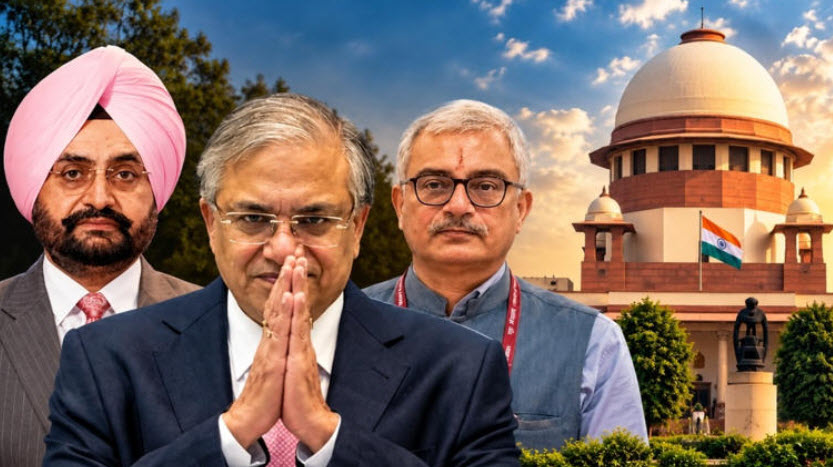
In a counter-affidavit filed on October 26, the Commission invoked Article 324(5) of the Constitution, which stipulates that a Chief Election Commissioner can be removed only in the same manner and on the same grounds as a Supreme Court judge.
The Commission also rejected allegations that Kumar had taken decisions concerning the Special Intensive Revision (SIR) of electoral rolls without the consent of fellow Election Commissioners Sukhbir Singh Sandhu and Vivek Joshi. It maintained that its three principal SIR orders were approved unanimously.
The response concerns a petition by Rakesh Kumar Singh questioning whether the Chief Election Commissioner could individually exercise powers vested in the three-member constitutional body. The petitioner sought judicial intervention over alleged departures from collective decision-making and asked that Kumar be restrained from functioning.
The Commission argued that the petition relied entirely on one newspaper investigation without independently establishing the allegations. It said the petitioner had neither approached the Commission for clarification nor sought to verify the underlying facts before requesting extraordinary judicial relief.
The affidavit stated that a newspaper account could not, by itself, establish the truth of its contents. The Commission also pointed out that the petition did not challenge the legality of its composition or dispute that Kumar had been appointed in accordance with the law.
It consequently described the request for a writ of quo warranto, requiring a public officeholder to establish the authority under which the position is held, as misconceived.
The Commission further relied on Section 18 of the Chief Election Commissioner and other Election Commissioners (Appointment, Conditions of Service and Term of Office) Act, 2023. The provision requires members to endeavour to reach unanimous decisions and provides for majority decisions when they disagree.
Restraining the Chief Election Commissioner, the affidavit argued, would interfere with the statutory arrangements through which the constitutional body conducts its business. These submissions represent the Commission’s position before the court, rather than a judicial determination of the petition’s merits.
The Commission said orders governing the SIR issued in June 2025, October 2025 and May 2026 had received the agreement of all three members. It distinguished questions, comments and suggestions recorded during internal file circulation from final decisions formally approved by the Commission.
According to its account, files move through both Election Commissioners before reaching the Chief Election Commissioner. Urgent approvals may be obtained electronically and subsequently recorded. Decisions are then implemented through the Commission’s secretariat.
The affidavit itself, filed through Deputy Election Commissioner Bhanu Prakash Yeturu, was unanimously approved by Kumar, Sandhu and Joshi, the Commission said. It denied authorising the release of internal notes or files to the press.
The proceedings follow allegations that objections by the two Election Commissioners had been disregarded in decisions connected with the electoral roll revision exercise. Those allegations remain contested, and the Supreme Court has not established that Kumar acted without the requisite authority.
On October 5, a Supreme Court bench headed by Chief Justice Surya Kant declined to suspend Kumar through an interim order without hearing the other side. The court nevertheless agreed to examine the challenged decisions and their compatibility with the governing law.
The matter was listed for further hearing on Tuesday, October 27. The Commission requested permission to submit a fuller, paragraph-by-paragraph response, explaining that its immediate affidavit had been prepared amid the Dussehra court vacation.
Addressing a separate issue concerning voter registration, the Commission maintained that Form 6, used for applications to enter electoral rolls, had not been amended. It said an additional SIR declaration was a separate document, although its online presentation could have created confusion.
The Commission said the online application process had been adjusted from October 21 to distinguish the two documents. It also maintained that changes to voter records on its digital platform require an order from the appropriate Electoral Registration Officer.
For voters whose details cannot be matched during the revision exercise, the Commission said booth-level officers would ordinarily collect supporting documents at their homes, with personal hearings reserved for exceptional circumstances. Such hearings would preferably be conducted online, while officials would seek necessary documentation directly from households wherever that was feasible.