By Arun Srivastava
“Chorbagan. Think about whose hands the state has been handed over to after driving away the ‘bad’ Mamata Banerjee. They are ‘good people’. They do not speak Bengali. They wear saffron stoles around their necks. They say, ‘Yeh hamara Vidhan sabha hai’ [This is our assembly]. And they tell blatant lies. Even when 19 people die, they say nothing has happened. In the Bengal of change, the puja committee head Jayanta Banerjee was forced to resign and the puja was handed over to them.”
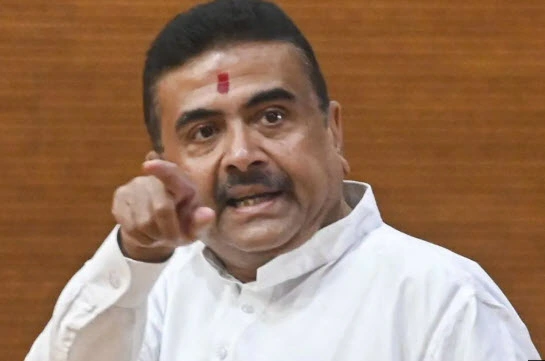
These are the words uttered by a Bengali citizen of Kolkata posted recently on Facebook. They reflect on the visible decline of Bengali cultural and social ethos under the current BJP government led by Chief Minister Suvendu Adhikari, who is trying to aggressively establish a new right-wing political hegemony in the state, despite encompassing ideological contradictions.
Adhikari’s claims of replacing the traditional center-left, secular-regional narratives of Bengal with a strident Hindutva and ultranationalist political alignment sound grandiose. The political shifting of Bengal’s ideological narrative still remains a highly polarized debate. Although CM Suvendu is hellbent on following a hardline Hindutva politics, it struggles against deep-rooted historical currents: Bengal’s political identity is historically anchored in secular-regional pride, heavily influenced by the 19th-century Bengal Renaissance and the inclusive cultural paradigms of figures like Rabindranath Tagore and Kazi Nazrul Islam.
Secondly, Adhikari himself has been a product of secular politics and has spent the majority of his political career within a secular ambience, which is why his 180-degree saffron embrace after joining the BJP in 2018 and becoming the CM in 2026, feels opportunist and ridiculous to the discerning citizens. Moreover, in the light of TMC’s previously successful deployment of the “Bengali sub-nationalism” to counter BJP’s Hindi-Hindu nationalism, CM Suvendu’s shift ought to be viewed as an electoral tactic, rather than a deep-seated ideological transformation.
Ideological anachronism is explicit in the deepening feud in the saffron ecosystem on the issue of ransacking of book stalls set up during Durga Puja by the CPI(M). The progressive left-wing bookstalls were attacked and vandalised by the saffron goons across the state. Extending full support to that saffron vandalism, CM Suvendu said: “We will not allow anyone to publish anti-national or anti-Sanatan writings, or to hurt any religion, on the soil of West Bengal.” However, other senior leaders of the West Bengal unit of the party, including state BJP president Samik Bhattacharya, finance minister Swapan Dasgupta, senior RSS leader Jishnu Basu, openly condemned the destruction, exposing a significant tactical and ideological divide within the ruling camp.
Swapan Dasgupta went public with his disapproval, stating he was “ashamed” to see the vandalism. He explicitly stated that despite deep ideological differences with the Left, that alone “cannot justify destroying books”, or deploying bulldozers to crush freedom of expression. Jishnu Basu aligned with Dasgupta, calling the ransacking an “act of cowardice” and affirming that there is no pride to be found in destroying books. He also questioned who was behind the alleged vandalism and whether anyone had authorised such acts in the name of the BJP. He urged his party and the state government to ensure that such incidents did not recur.
Bengal has a deeply ingrained historical reverence for literature and intellectual pluralism. For generations, regardless of political affiliation, setting up book stalls during Durga Puja has been a peaceful civic tradition. Senior BJP and RSS leaders acknowledge that bulldozing book shops would alienate the Bengali middle-class (bhadralok section) and independent voters. They viewed the horrifying visuals as a public relations disaster that painted the new government as anti-intellectual and authoritarian.
As Chief Minister, Adhikari advocates for a high-velocity expansion model, actively encouraging defectors to build a legislative majority. Yet, the BJP’s traditional old guard warn against this rapid absorption, arguing it could dilute the party’s long-term ideological coherence. The friction is best understood as a mix of tactical disagreements on how the BJP should rule West Bengal, combined with an internal power struggle between the established organizational machinery and an ambitious, newer leadership circle.
CM Suvendu’s governance borrows the TMC’s political toolkit. According to it, the political shift actively redefines “Bengaliness” (Bangaliyana), blending regional pride with a broader, assertive pan-Indian Hindu identity, particularly in rural areas. Adhikari intends to give it the shape of permanent realignment. BJP government exercise to replace “Biswa Bangla” logo, discontinuing separate state flags/songs introduced by the TMC, and renaming prominent roadways are part of this design.
CM Suvendu has openly called for a new phase of “Sanatan rule,” emphasising Hindu identity as much as, if not above and beyond, Bengaliness. This is new for West Bengal, because until BJP’s controversial victory in May 2026, the previous governments have all been avowedly secular in form and character. CM Suvendu’s nascent Hindutva evangelism is confronted with the reality wherein the vast majority of ordinary Bengali Hindus do not know about the technical, historical, or scriptural differences between “traditional Hinduism” and “Sanatana Dharma.” For Hindus, the two terms are used interchangeably as synonyms for their faith.
The term “Sanatan” translates to “eternal order,” “eternal law,” or “eternal way of life.”For an average Hindu practicing daily rituals, going to temples, and celebrating festivals, Hinduism is akin to Sanatan Dharma. If you ask a practitioner what his religion is, he would invariably say “Hindu.” If you ask him what the “original” name of his religion is, he will answer “Sanatana Dharma”. The saffronised Sanatan Dharma push is confusing for a common Hindu, the primary reason being that the Hindutva nationalists themselves do not have clear perception of Sanatan Dharma. The fact is those who study the Vedas, Upanishads, or history understand that a “Sanatana Hindu” and a “Traditional/Institutional Hindu” are virtually operating within the same frameworks.
CM Suvendu’s aggressive Sanatan Dharma push should therefore be seen as more of an act of one-upmanship to secure his peak position within the West Bengal BJP. Purely with the intention to outwit senior BJP leaders and project himself as the supreme Hindu nationalist Bengali leader, Adhikari has described his rule as a new era of “Sanatan rule” in the state, while many BJP leaders hold the view that Bengal needs political change focused on cultural identity, development, governance reforms, and stronger connection with traditional values. There is no doubt that CM Suvendu has been resorting to his tactics to further communal polarization in the state, and thus reap electoral and political dividends from the party high command in Delhi.
While modern political debates frame Sanatana as a misleading or vague slogan—often because many everyday practitioners may not articulate its deep philosophical definition—the term holds a foundational place in Indian philosophy. CM Suvendu ought to know that Sanatana Dharma is built on universal values and cosmic principles that guide human life. Whether Sanatana functions as a misleading slogan depends entirely on the context in which it is used. In the context of philosophy and history, it represents the foundational, eternal framework of the spiritual and moral duties that define the Hindu way of life.
Bengal’s historical ethos is heavily anchored in the universal humanism, secular reform, and syncretic philosophy of icons like Rabindranath Tagore, Swami Vivekananda, Kazi Nazrul Islam, and Raja Rammohun Roy. BJP’s attempt to adapt these figures into a rigid nationalist narrative often feels inorganic to the local electorate. Moreover, having been ruled by the fiercely secular Left Front for 34 consecutive years, the political vocabulary of West Bengal remains steeped in class solidarity, social welfare, and localized party networks. This makes it difficult for purely religious or ideological polarisation to permanently override economic and welfare-driven voting habits.
RSS and BJP have tried to project Dr Shyama Prasad Mukherjee as an alternate to the Bengali cultural and academic stalwarts, but it has not caught the imagination of the common Bengali. The perception that a philosophy cannot be easily dismissed as irrelevant when its political vehicle commands a massive portion of the state’s electorate is not correct. Electoral gain cannot absolutely be bracketed with ideology or philosophy. Quite interestingly, the relationship and political dynamics between the TMC and BJP are subjects of intense debate among political analysts, intellectuals and academics within Bengal.
Political culture of Bengal has maintained certain structural continuities, regardless of the party in power or the one challenging it. This perspective highlights several key areas. BJP’s poaching of former TMC leaders, legislators, and grassroots organizers to build up its organizational strength in the state. Expectedly, the BJP has inherently absorbed the same political methods, networks, and localized power structures used by the TMC. These turncoats are a major threat to the ideological and philosophical existence of RSS and BJP.
The BJP’s politics remains deeply rooted in Hindutva (ideological nationalism) and a distinct nationalist framework, aiming to integrate West Bengal into its broader pan-Indian political narrative. In contrast, the TMC positions itself around Bengali regional identity, sub-nationalism, and secular pluralism, explicitly fighting against what it terms “outsider” political influences and pursuing subaltern politics. It cannot be denied that even the Bengal BJP’s politics is an extension of the existing political culture due to structural reliance on local elements.
Aware of the fact that it cannot counter the TMC’s philosophical stance on “Bengali Pride”, the BJP has shown keenness to woo the non-Bengalis, who constitute around 18 percent of the state’s population. Non-Bengalis had earlier rallied behind the Communist Party of India (Marxist) for acquiring the status of independent identity. But their hopes were belied. A number of these people migrated to BJP. A big chunk of Bengali cadres also shifted to the BJP driven by a compulsion of ideological stagnation, organizational paralysis, and structural survival instincts on the ground. The defection of a few left leaders and many voters to the right-wing BJP—often described locally as a shift from” Baam (Left) to Ram”—was largely driven by existential survival rather than ideological conversion.
The political future of West Bengal remains a subject of intense struggle, as the state experiences a major structural transition. The sentiment that Trinamool’s style of politics—defined by regionalism, Bengali identity, and expansive subaltern welfarism— may as well continue to dictate the state’s future relies on deeply rooted cultural factors: Trinamool’s core appeal was to rely heavily on secular pluralism and regional pride (“Joy Bangla”), framing the BJP as an outside force.
The weakening of a long-sustained political regime, therefore, requires an understanding of broader socio-economic linkages. In the case of West Bengal, opposition to Banerjee increasingly appears to reflect the consolidation of an unusual yet historically significant alliance between the urban middle class, upwardly mobile rural groups and dominant corporate interests. These groups may differ sharply in their social composition and immediate political priorities, but they are gradually converging around a shared discontent centered on redistributive politics and welfare-oriented governance.
The BJP is heavily supported by non-Bengali and Hindi-speaking demographics. With their help the party leverages the concept of a “New Bengal”. While TMC had historically embedded its ideology within Bengali sub-nationalism and linguistic identity, while the BJP has successfully mobilized the aspirations of non-Bengali populations alongside a broader nationalistic framework. Remaking West Bengal is on the cards, and CM Suvendu Adhikari might be holding some. (IPA Service)