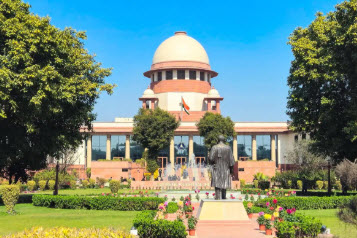
By Dr. Gyan Pathak
In a most significant observation, the Supreme Court of India said on Monday, October 5, if any decision taken by the Election Commission is found not to be in accordance with law, the court can annul it. The Supreme Court issued notices to and sought reply in a week from CEC Gyanesh Kumar, Election Commission of India (ECI), Election Commissioners Sukhbir Singh Sandhu and Vivek Joshi, as well as ECI Director General (IT) Seema Khanna and Senior Deputy Election Commissioner Maneesh Garg as well as the Centre.
While hearing two petitions against the CEC Gyanesh Kumar alleging him that the took decisions unilaterally without the approval of the other two Election Commissioners, the bench of Chief Justice of India (CJI) Surya Kant, Justice Joymalya Bagchi and Justice V Mohanna, also made a most damaging observation for the CEC “Any modified Form ^ has not been approved by us.”
This observation matters enormously since the modified Form 6 reportedly introduced an additional declaration concerning whether an applicant or his/her parents had been included in the previous SIR. The controversy is whether such a substantive change could be introduced administratively/software-wise or whether it required amendment of the relevant electoral rules.
The two cases the Supreme Court was hearing were Rakesh Kumar Singh v. Union of India and Shailendra Mani Tripathi v. Union of India. They concern alleged unilateral decisions in the name of the ECI, including matters connected with SIR and electoral-roll management.
Another significant observation of the bench was, “We have to issue notice. After notice, if they come and the reports show that an Election Commission decision was neither by majority nor by unanimity, they will have to explain those decisions.”
In the PIL case filed by a Patna resident Rakesh Kumar Singh, it was urged that the top court determine whether Chief Election Commissioner (CEC) Kumar has been individually exercising powers that legally belong to the ECI as a whole, and, if so, to declare those actions unauthorised and take appropriate legal action.
Senior advocate Vikash Singh for the petitioner said that the 2023 Act expands the ambit of immunity from legal action in favour of the CEC. Justice J. Joymalya Bagchi said that even judges are not given the protection given to the CEC in Section 16 of the 2023 Act. In this matter the Supreme Court issued notices to the Centre and the Election Commission.
The petitioner has sought suspension of the CEC Gyanesh Kumar, but the Bench refused to immediately take such an action because it did not want to act merely on the basis of a newspaper report. But it made an unusually consequential statement: If any decision taken by the Election Commission is found not to be in accordance with law, the Court can annul it. When the petitioned insisted on relief and direction, CJI said, “We have to have some authentic information before us. Let us wait for 10 days.”
The court observed, “If there is anything wrong with the decisions, we can always annul them. The 1993 amendment as well as the 2023 Act talk about both things. The procedure for transaction of business is to be decided unanimously, while functioning can be by majority. They are expected to first take a decision unanimously. If there is no unanimity, then, as rightly pointed out, it can be decided by majority.”
The Court specifically said that it presumes that ECI decisions have been taken according to law until evidence establishes otherwise. It declined the immediate request to suspend the CEC and said, in effect, give us the records and the ECI’s explanation first.
The second petition filed against the CEC by advocate Shailendra Mani Tripathi has sought constitution of an independent, high-powered Judicial Inquiry Commission or Special Investigation Team headed by a retired apex court judge to probe allegations against CEC Gyanesh Kumar.
This petition urged an investigation that must encompass, among others, an end-to-end audit of the Election Commission databases and probe the institutional circumstances under which 13 crore names were deleted across 30 States/Union Territories under the Special Intensive Revision. It also sought that CEC be divested of any statutory or constitutional immunity under the 2023 Act, saying that the CEC remains directly accountable under the law — subject to police investigation, evidence gathering, and regular trial proceedings as an “ordinary accused”. The CJI said that the court would tag the petition with the earlier one.
Today’s proceedings potentially revive that institutional principle in a much sharper factual setting. Court has chosen to investigate the institutional decision-making process of the ECI. It could potentially affect the legality of individual SIR decisions, electoral roll decision, Form 6 modification, decisions allegedly taken without concurrence of the other commissioners, and the validity of administrative orders issued in the ECI’s name. The court has indicated to also examine the issue of lifelong immunity of CEC.
There is a separate case relating to the validity of the 2023 appointment of CEC and ECs Act, which is most likely to be heard by another bench to be constituted in near future. (IPA Service)