By T Neelakantan Aiyers
US President Donald Trump’s embrace of India’s voter-ID system opens a larger debate: can the world’s oldest democracy borrow election-management lessons from the world’s largest?
For decades, Americans have lectured the rest of the world about the sanctity of elections. Now, remarkably, the lesson may be travelling in the opposite direction.
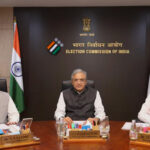
President Donald Trump has turned to India as an example of how America could make its elections more secure. In a recent Truth Social intervention, Trump praised India’s voter-identification system, cited the participation of about 646 million voters in the 2024 Lok Sabha election, noted the tiny proportion of votes cast by post and singled out Chief Election Commissioner Gyanesh Kumar for explaining the Indian system to him.
Trump’s timing is significant. He is pressing Congress to pass the SAVE America Act – the Safeguard American Voter Eligibility Act – which would require documentary proof of US citizenship when registering for federal elections and photo identification when voting. It would also require states to take continuing steps to identify and remove non-citizens from federal voter rolls.
The question, however, is not whether America should copy India. It should not. The more interesting question is whether America can learn from India’s underlying philosophy: identify the voter, maintain a continuously cleaned electoral roll and make the ballot difficult to separate from the legitimate voter who cast it. That is a very different proposition.
America’s extraordinary electoral patchwork; The United States does not have one national election system in the way India does. American elections are primarily administered by states and, in many places, counties and municipalities. Federal law provides important standards, but registration, identification, early voting, absentee voting, ballot design, voting equipment and election administration vary substantially from state to state.
The US Election Assistance Commission says every state and territory except North Dakota requires voter registration for federal elections, with states maintaining their own computerized voter-registration systems.
That decentralisation is one of the strengths of American federalism. It is also its vulnerability. A presidential election is effectively 50 state elections conducted simultaneously, with thousands of local jurisdictions operating under different rules.
America therefore has no universally applicable equivalent of India’s Election Commission of India – an independent constitutional authority under Article 324 charged with supervising elections across the country.
India has built a national electoral architecture around a single constitutional election authority, a common voter-identification framework, electoral photo identity cards, standardised procedures and electronic voting machines with VVPAT paper trails. The ECI says its 2024 Lok Sabha election involved 97.98 crore registered electors, with 64.64 crore votes cast, including 64.21 crore EVM votes and 42.82 lakh postal votes.
That is the number Trump was referring to – approximately 646 million actual votes, not merely registered voters. And there is a lesson here that goes beyond voter ID.
India’s real innovation is the electoral roll; The most important Indian lesson for America may not be the voter card at all. It may be the electoral roll. India’s Election Commission is currently conducting a Special Intensive Revision (SIR) of electoral rolls. Its stated objective is to identify and eliminate ineligible entries while ensuring that eligible citizens remain enrolled. The ECI’s voter portal specifically provides facilities for enumeration, checking names in the previous roll, submitting documents and seeking deletion or correction.
The exercise has been controversial. Critics have complained that genuine voters can be asked to provide documentation and that the process can create bureaucratic barriers, with concerns about wrongful exclusions. That criticism should not be dismissed. An electoral roll is not merely an administrative database. It is the gateway to a constitutional right. Removing a bogus name is desirable; accidentally removing a genuine citizen is unacceptable.
Yet the principle behind SIR is difficult to dismiss: electoral rolls cannot be treated as permanent documents. People die, move, change addresses, acquire or lose eligibility and sometimes appear more than once. A democracy needs a mechanism for continuously reconciling its voter database with reality.
The ECI has described the Indian revision process as targeting categories such as absent, shifted, deceased, duplicate and foreign voters while seeking to ensure that every eligible citizen aged 18 and above is enrolled.
This is precisely where America could learn from India – provided it builds stronger safeguards against wrongful deletion.
What Trump wants: The SAVE America Act goes further than simply asking voters to show an ID. The legislation would require documentary proof of US citizenship for registration for federal elections and an eligible photo ID for voting. The bill specifies documents such as qualifying REAL ID identification, a US passport and certain government-issued documents. It also provides an alternative process for citizens unable to produce the specified documents.
For absentee voters, the bill would require identification documentation at both the request and submission stages. This is a dramatic departure from the American tradition in which voter identification rules differ among states.
But there is a legitimate counter-argument. The United States has millions of citizens who may not possess a passport, may not drive and may encounter difficulties obtaining documentary proof of citizenship. If Washington makes identification compulsory, it must simultaneously guarantee free, easily obtainable identification.
Otherwise voter security can become voter exclusion. The objective should be to make voting harder for a fraudulent voter, not harder for a legitimate voter.
Britain has already moved closer to the American debate; Britain offers an important comparison because it historically relied much less on mandatory voter identification than India. That has changed.
Photo ID is now required for UK parliamentary elections and several English and Northern Irish elections, although the rules vary across the United Kingdom. Scotland and Wales retain different arrangements for devolved and local elections.
Britain also permits postal voting, subject to registration requirements. Applicants can be required to provide a National Insurance number or other identity documents. Britain therefore demonstrates something important for America: voter ID and postal voting are not mutually exclusive concepts. The real issue is the authentication chain.
Continental Europe is even more instructive; France requires identity documents at polling stations in municipalities with 1,000 or more inhabitants. Acceptable documents include a national identity card, passport, driving licence and several other government-issued photographic documents. The electoral card itself is not an identity document and is not mandatory for voting.
Italy similarly requires voters to present an electoral card together with an acceptable identity document. Italian authorities permit several forms of photographic identification, including identity cards and driving licences.
Germany and Spain also operate within European systems in which voter eligibility is established through official electoral registers rather than America’s unusually fragmented registration architecture.
The broader European model is therefore closer to India’s philosophy than America’s traditional approach: the state knows who is entitled to vote, the voter establishes identity and the electoral authority manages the roll.
But Europe does not offer one uniform model. Some countries rely heavily on national population registers; others use electoral registers linked to municipal administration. Postal and proxy voting arrangements also vary. That is why the American debate should not become a simplistic argument about “Indian versus American democracy.”
The Indian model has its own vulnerabilities; Trump’s admiration should not become an uncritical endorsement. India’s election machinery is extraordinary in scale, but it is not beyond criticism. The current SIR controversy demonstrates the danger of aggressive roll purification. If officials remove legitimate voters faster than they can correct mistakes, electoral integrity can paradoxically be weakened.
India’s EVM system has also been the subject of political controversy, although the Election Commission maintains extensive procedural and technical safeguards, including VVPAT. (IPA Service)