By Arun Srivastava
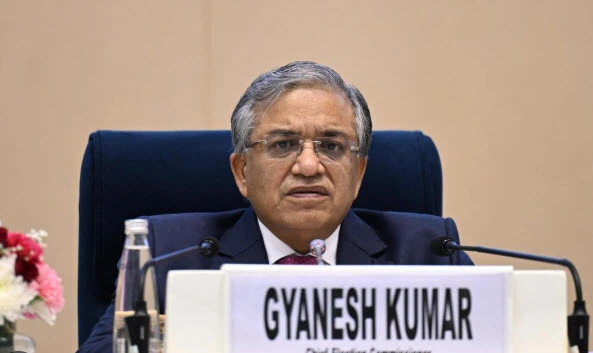
It has not been a simple case of Vote Chori (theft of votes) as alleged by Rahul Gandhi a year back. Instead, what has been exposed is the design itself of how CEC Gyanesh Kumar, at the instructions of his saffron masters in the Centre plotted to strangulate India’s democracy and the Constitution by centralising the entire electoral data through the IT system functioning on the lines of the IT cell of the saffron ecosystem. Else, there was no tangible reason for Gyanesh not to listen to his two Election Commission colleagues – Sukhbir Singh Sandhu and Vivek Joshi – and act unilaterally to precipitate mass voter deletions and put the very principle of universal adult franchise in grave peril.
The CEC, now in the eye of a political super-cyclone following the explosive revelations in the Indian Express, had in 2023, gone on to mislead and betray the trust of the Supreme Court of India by persuading it to believe that the Special Intensive Revision (SIR) was not intended to be exclusionary, but to clean up the voters’ list by removing duplicate entries, the names of those who have changed their place of residence, dead voters and infiltrators who falsely claim to be Indian citizens.
Not only was the Supreme Court taken for ride by CEC Gyanesh Gupta, he also managed to make the apex court overlook the many objections submitted by conscientious petitioners who had expressed deficit of trust in the CEC as well as in the very process of the SIR. Why the Supreme Court did not ask the CEC the reasons for his urgency in executing SIR remains in doubt till this day.
Regrettably, the Supreme Court even did not even honour its own words that if any concrete evidence of discrepancy was found it would cancel the SIR, notwithstanding one of the petitioners producing ten persons who have been declared “dead” by the Election Commission of India’s draft electoral rolls during the SIR in Bihar.
It would not be an exaggeration to say that the judiciary not only abdicated its responsibility to the people of India, it also did not fulfil its obligation to the Constitution and democracy. It acted as a passive spectator and paid obeisance to the funeral of democracy engineered by the CEC Gyanesh, of course at the behest of the executive. It is amply clear from the expose by the Indian Express that CEC Gyanesh would not have dared to distort the constitutional functioning and subverted democratic process, if CJI had put his foot down and not endorsed the launching of SIR as legal and constitutional.
The demand to scrap the SIR was made shortly after the ECI formally issued the initial notification mandating the state-wide SIR of electoral rolls on June 24, 2025. Following this, lawyers representing petitioners like the Association for Democratic Reforms (ADR) immediately moved the Supreme Court, officially seeking the scrapping of the SIR order on the grounds that it was unconstitutional and threatened to disenfranchise lakhs of marginalized voters. The Supreme Court heard the petitions challenging the order on July 7, 2025, but instead of scrapping SIR, it upheld the constitutional validity of the Bihar SIR exercise, noting that adopting a different procedure did not inherently violate the law. The SC judgment thus emboldened CEC Gyanesh to indulge in extra-constitutional actions.
Court verdicts have massive future implications because they establish legal precedents that dictate how future laws are interpreted, how lower courts rule, and how society operates. Under the principle of stare decisis (to stand by things decided), a single landmark ruling can reshape civil rights, corporate regulations, and government powers for generations. Rulings by higher courts (like a Supreme Court) become mandatory rules that lower courts must follow in similar future cases.
For a common Indian, Supreme Court is the last hope to get justice, to protect him from the autocratic rule, his rights and interests and ensure his survival. But unfortunately, this did not happen as around 18 crore people have been disenfranchised and are now facing the incomprehensible threat of losing their citizenship. Did the judiciary not realise that a shoddy and hastily done SIR would turn millions of people non-voters and eventually non-citizens in their homeland, creating entire generations of stateless people in our country? What sort of judicial lapse fails to surmise the enormity of the consequences of the actions that were given constitutional sanctity that have now caused so much misery for the ordinary people of India?
The inference that the ECI deliberately deleted names to help the BJP electorally, gains credence from what has been found by the tribunals set up by the Supreme Court to adjudicate the claims of voters whose names were deleted and whose appeals could not be decided before the publication of the final voters’ list. In this context, the reply to the Right to Information application filed by Congress MP Isha Khan Choudhury revealed that the total number of appeals submitted for adjudication was 38,10,620, of which only 82,782 (a bare 2.17 percent) have been disposed of thus far. Of the deleted names, 75,443 (about 91 percent) were restored, while 7,339 (a bare 8.86 per cent) were excluded.
While hearing the Delhi SIR case, the Supreme Court of India expressed its concerns regarding the “logical discrepancy” on September 22, 2026 and observed that the notices issued to over 33 lakh voters appeared to have been generated “almost mechanically” and by machines without proper human filtration. The court asked the Election Commission of India to clarify the operational guidelines and definitions governing these “logical discrepancies” so that voters are not arbitrarily disenfranchised. But the court did not take up the issue of logical discrepancy in case of West Bengal, where ECI had deployed it in November 2025, for the first time in the electoral history of India. Approximately 27 lakh (2.7 million) voters in West Bengal were excluded from the electoral rolls on the grounds of “logical discrepancies”. Significantly, the CJI criticized the term “logical discrepancy” for being too abstract for ordinary citizens.
The two ECs formally recorded objections on file at least 14 times over 10 months. They alleged that critical decisions—including changing the voter registration Form 6 on the portal and centralizing access to the voter databases—were issued under the name of the full Commission without their knowledge or authorization, which they described as “unauthorised and illegal”. This is most grievous allegation against CEC Gyanesh Gupta. The two ECs – Sandhu and Joshi – also noted that Form 6 was modified on the ECINet portal to demand background checks on whether an applicant’s parents or grandparents existed in the last SIR, a step they argued could not legally be done without formal amendments to the rules via Parliament.
Critics point out that the Supreme Court’s inability to halt the 2023 law allowed a centralized system to take root. In the SIR process—the nationwide cleanup of electoral rolls—it is the central operational control of verifying electoral rolls that is being challenged. Supreme Court upholding the legality of SIR effectively gave the legal go-ahead to the process that resulted in the removal or alteration of millions of draft voter names across multiple states.
Electoral Registration Officers (EROs) hold the sole legal authority to add or delete names from voter lists under the Representation of the People Act, 1950. However, recent revelations show that this authority was severely restricted through centralised software controlled by the ECI’s IT division. CEC Gyanesh Gupta and the Director General of IT Dr. Seema Khanna, utilised the newly rolled-out ECINet / ERONet software to centralize control. This system effectively locked on-ground EROs out of making database corrections or rollbacks. Election Commissioners Sukhbir Singh Sandhu and Vivek Joshi formally filed 14 notes of dissent against CEC Gyanesh Kumar’s directives, specifically questioning whether the DG (IT) had any legal right to restrict the statutory autonomy of ground-level election officials.
Joshi and Sandhu wrote separately to the Cabinet Secretary complaining about changes in work allocation that, in effect, removed a layer of oversight of the IT backbone for the electoral rolls. They made it clear: these changes had been done without their knowledge and they struck them down. It was after this, on September 9, that the CEC and the two ECs met, their first full meeting in four months.
The SIR was used as the tool to ensure victory of BJP in West Bengal Assembly polls. Of the 294 seats that went to polls, in 49, the SIR deletions exceeded the victory margin. But in these, the spoils were almost evenly shared — 26 were won by BJP and 21 by TMC. But the manner in which names were struck off prompted the Supreme Court, in February 2026, to take the last leg of the SIR out of the Commission’s hands and get judicial officers to decide on the plight of 60 lakh voters flagged for “logical discrepancies.” Of these, 27 lakh electors were subsequently deleted by the Commission. The court then ordered tribunals of retired High Court judges to hear appeals against those decisions. The Court could have stayed the process of logical discrepancy altogether in order to protect peoples’ fundamental right to vote.
After the expose, the Opposition has woken up to its political responsibilities and demanded the resignation and arrest of CEC Gyanesh Gupta. It is indeed an infantile demand. Probably, they have forgotten the fact that the CEC enjoys legal immunity, as per the 2023 law. He cannot be arrested as legal provisions enacted by Narendra Modi government, bar courts from entertaining civil or criminal proceedings against Election Commissioners for actions connected to discharging their official duties. Section 16 of the Chief Election Commissioner and Other Election Commissioners Act, 2023—which was enacted by the Modi government—serving and former Election Commissioners are shielded from specified civil or criminal proceedings for actions or statements made while discharging their official duties. The question that is making rounds of the political circle is; whether Supreme Court would take any action against CEC Gyanesh Gupta after these damning revelations? (IPA Service)